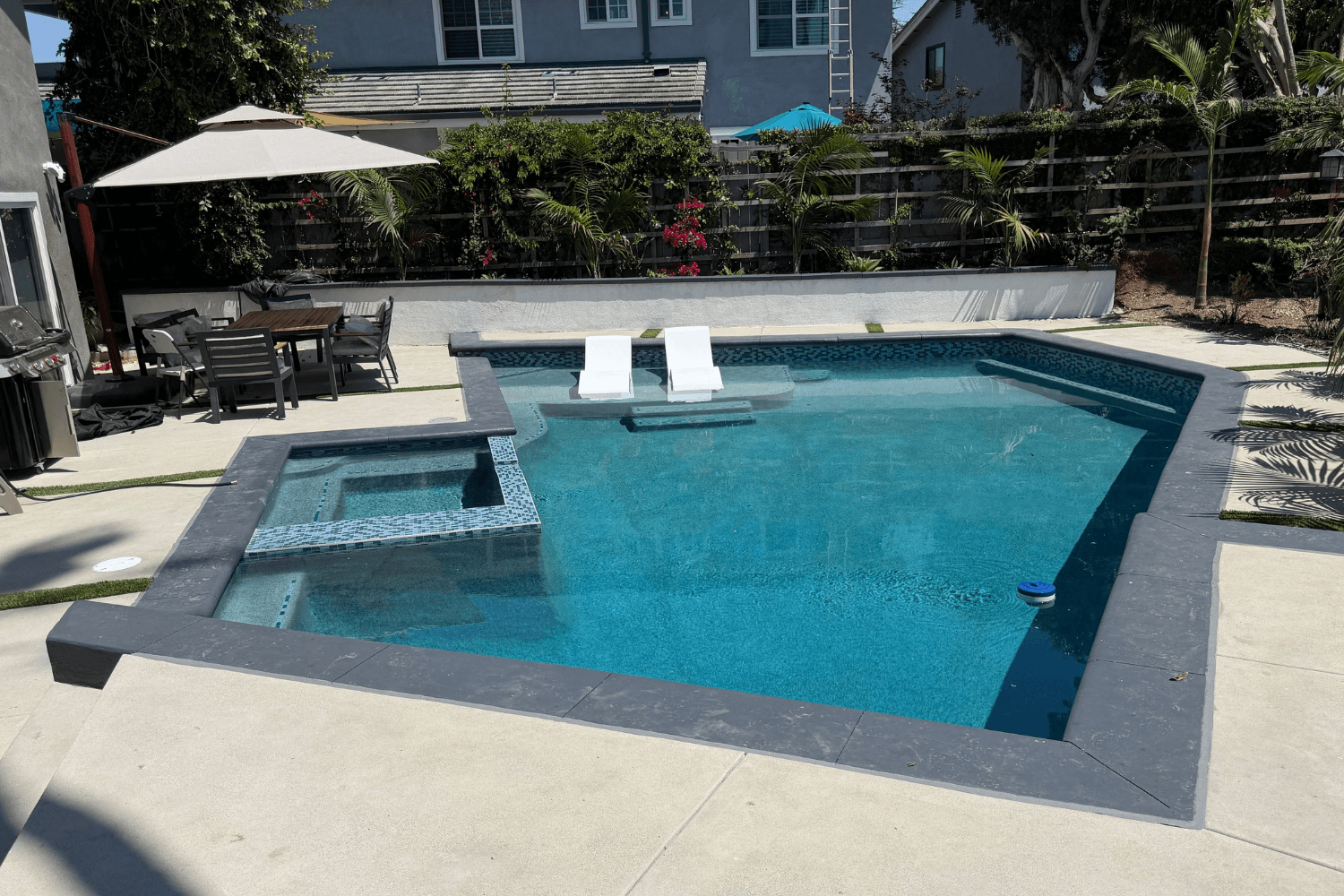
Is a Tanning Ledge a Safe Play Area? What Parents Should Know About Baja Shelves
A few inches of water, room to sit beside your toddler, and a place to cool off without taking a full swim: it is easy to see why tanning ledges appeal to families.
Also called Baja shelves or sun shelves, these shallow platforms are built into or alongside a pool. They provide space for lounging and wading, and pool-design articles sometimes describe them as safe zones for young children.
But that description needs an important qualification. A tanning ledge can be a place for supervised play; it is not a place where shallow water makes supervision optional. The American Academy of Pediatrics warns that toddlers can drown in less than two inches of water and recommends keeping an adult within arm’s reach around water.
The distinction is between shallow and protected. A ledge describes the pool’s design, not the level of protection it provides.
At All-Safe®, we encourage families to consider both how they will use the shelf during pool time and how they will prevent unsupervised access when swimming is over.
A Tanning Ledge Is Still Part of the Pool
A tanning ledge provides a shallow surface where someone can sit, stand, or wade without fully swimming. Its dimensions and water depth vary by design, so the name alone does not tell you how suitable a particular shelf is for your family’s activities.
Before treating it as a children’s play area, look at the actual layout:
Where does the shallow platform end?
How does it connect to the rest of the pool?
Are there steps between the shelf and deeper water?
How much usable space remains when furniture is in place?
Where will the supervising adult position themselves?
These questions matter because the shallow section is not necessarily physically separated from the rest of the water. A rule such as “stay on the shelf” is not the same as a barrier preventing access to deeper areas.
Nor does a child’s ability to stand establish that the area is safe for independent play. AAP guidance makes clear that even knowing how to swim does not mean a young child is safe in or near water.
Think of the ledge as a setting for shared pool time, not a substitute for the adult support your child needs.
Supervise From the Water, Not Just From a Nearby Chair
The appeal of a tanning ledge is that adults and children can enjoy the same space differently. One person may want to recline while a toddler splashes nearby.
That convenience can blur the distinction between being present and actively supervising.
For infants and toddlers, the AAP recommends that an adult be in the water and within arm’s reach, providing “touch supervision.” For older children, supervision still means constant attention without distractions such as phone use, socializing, household tasks, or alcohol.
On a tanning ledge, ask yourself a practical question: from where you are sitting or standing, can you actually reach your child immediately?
Being on the same shelf does not automatically mean you are close enough. A phone, a conversation, or a reclined position can also compete with the attention required for supervision.
Name the supervising adult
When several adults are using the pool, make responsibility explicit. Do not assume that the person closest to the shelf is watching, or that everyone is taking turns without discussing it.
Agree on who is supervising before children enter the water. If that adult needs to leave or stop watching, another adult should knowingly take over. The underlying requirement remains the same: someone must actively watch children throughout pool use.
The ledge may make it easier to spend time together, but it should not make responsibility less clear.
Make the Transition to Deeper Water Part of Your Plan
The shelf’s edge deserves as much attention as its shallow surface.
Walk through the layout without children first. Identify exactly where the depth changes, where the entry steps are, and where an adult can position themselves to stay close to a young child.
Then build your family’s pool routine around that actual design:
Enter the water together rather than sending a toddler ahead to the shelf.
Stay close enough to provide the supervision your child needs.
Explain the shelf boundary in age-appropriate language.
Treat those explanations as teaching, rather than a replacement for supervision.
Reassess adult positioning when children move or the activity changes.
For young children, understanding a rule and reliably following it are not protections you should depend on around water. AAP guidance calls for arm’s-reach supervision and physical barriers, even when a child has swimming skills.
A ledge can offer opportunities to practice entering the water, following directions, and becoming comfortable with the pool. Those activities still belong within a closely supervised setting.
Plan Furniture Around Family Use
A shelf shown with two loungers and an umbrella may look spacious in a design rendering. The more useful question is how it will work when adults and children are using it together.
Before choosing furniture, ask your pool builder or furniture manufacturer:
Is the furniture intended for the shelf’s actual water depth?
Where should it sit relative to steps and entry routes?
How much clear space will remain for an adult to accompany a child?
Will it need to be moved for the pool’s net or cover?
Where will it go when it is removed?
These are product- and layout-specific questions, not reasons to assume all loungers are unsuitable. Their purpose is to keep the planned use realistic.
Also consider where furniture is placed outside the water. The AAP advises keeping lawn furniture and other climbable objects away from pool fences so they cannot help a child get over the barrier.
A chair moved out of the pool should not create a new access problem beside the fence.
Include the Shelf Inside the Protected Pool Area
When pool time ends, the tanning ledge should not remain available as an unrestricted splash area.
Its shallow depth does not remove the need to limit unsupervised access. AAP guidance recommends fencing that completely surrounds the pool or spa, with a self-closing, self-latching gate; its toddler guidance calls for fencing on all four sides.
For a pool with a connected shelf, the practical planning question is how to protect access to the entire water area, not just the deeper swimming section.
Consider the route from the house and yard:
Can a child reach the ledge directly from a patio door?
Does the proposed fence enclose the shelf as well as the main pool?
Could someone mistakenly treat the shelf as outside the “real” pool area?
Will everyone responsible for the pool restore its protection after use?
A shallow section can feel more like part of the patio than part of the pool. Your access plan should reflect the water hazard, not just the visual impression.
Ask About Nets and Covers Before Finalizing the Setup
Pool fencing and over-water protection address access differently. A fence separates the pool area from the surrounding space, while a safety net is installed over the water. All-Safe® offers both approaches, along with pool cover options.
If your pool has a tanning ledge, show the complete layout to the installer before selecting a product. Include the shelf, steps, furniture, umbrella fittings, and any other features that could affect the proposed installation.
Ask the installer to explain:
How the selected product will protect the pool, including the shelf.
What needs to be removed or repositioned before installation.
How to confirm that the product is properly secured.
What to do if the pool layout or furniture changes.
Do not assume a product will fit around furniture or other features simply because the water is shallow. Compatibility needs to be confirmed for the specific system and installation.
It is also important to distinguish debris protection from child-safety protection. Leaf covers are useful for keeping a pool clean but not effective as standalone pool safety devices for children.
Ask what the proposed product is designed to do, not just whether it covers the water.
Questions to Ask Before Adding a Tanning Ledge
If you are planning a new pool or renovation, bring family use into the design conversation early.
Ask your builder or installer
What you need to understand
What will the actual water depth be?
Whether the design matches your intended activities and furniture
How does the shelf connect to deeper water?
Where children can move and where adults will supervise
Where will the pool barrier go?
How the entire water area will be protected
What furniture fits the proposed layout?
Whether usable space and entry routes remain practical
How will the selected net or cover work?
What installation and daily operation will require
What local requirements apply?
Which permits, barriers, and approvals must be addressed
These questions are more useful than asking whether a Baja shelf is “kid-friendly.” That phrase does not explain the depth, the transition into the pool, or the protection needed between swim sessions.
Enjoy the Feature Without Mistaking It for Protection
A tanning ledge can be an enjoyable place to spend time in the water together. The key is to separate what it offers; a shallow area for sitting, wading, and lounging, from what it does not offer: independent protection for a child.
During use, provide active supervision appropriate to the child’s age and swimming ability. Between uses, limit access to the pool, including its shallow sections. Those responsibilities remain important regardless of whether your pool has a sun shelf, Baja shelf, or traditional entry steps.
At All-Safe®, we can help you explore removable mesh pool fencing, safety nets, and cover options for your pool’s layout. Bring the tanning ledge into that conversation from the start so the protection plan accounts for the whole pool, not just the deepest water.
Request an installation quote to discuss your layout and the physical protection options available for your property.
A plunge or cocktail pool can fit a compact backyard, but its smaller footprint does not eliminate the need for protection. Learn what to consider before installation, from house-to-water access and fence placement to choosing a barrier that works with your space and routine.
Water safety matters even when no one plans to swim. For families of children who wander, preparation should extend beyond the backyard pool. Learn how to assess access to water, coordinate with neighbors, and build an individualized plan with your child’s care team.
A sliding deck pool cover does more than protect the water. When closed, it can conceal the pool and turn its footprint into usable outdoor space for relaxing, entertaining, and everyday backyard living. Learn whether this custom solution may be right for your pool project.